What Is Adderall 30mg Used For?
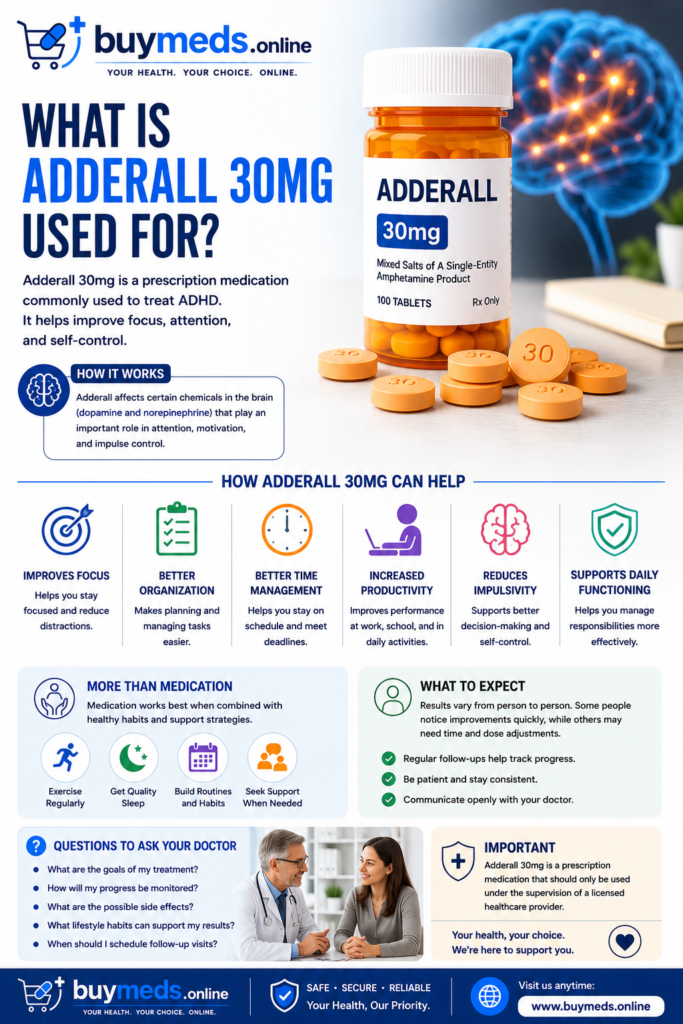
If you’ve recently heard about Adderall 30mg, you might be wondering what it is actually used for and why healthcare providers prescribe it. While many people recognize the name, fewer understand its purpose and how it fits into a treatment plan.
This article explains the basics in a simple and straightforward way.
Understanding ADHD
Attention Deficit Hyperactivity Disorder (ADHD) is a condition that affects how people focus, organize tasks, manage time, and control impulses. Although symptoms often begin during childhood, many adults continue to experience challenges later in life.
For some individuals, these difficulties can affect work performance, education, relationships, and daily responsibilities. As a result, healthcare providers may recommend treatment to help manage symptoms more effectively.
The Primary Purpose of Adderall 30mg
Adderall 30mg is commonly prescribed to help people with ADHD improve attention and concentration. The medication works on certain chemicals in the brain that play an important role in focus, motivation, and self-control.
When treatment is successful, patients may find it easier to:
- Stay focused on tasks
- Complete projects without becoming distracted
- Follow instructions more effectively
- Manage responsibilities at work or school
- Stay organized throughout the day
- Reduce impulsive behavior
However, results can vary from person to person. What works well for one individual may not produce the same experience for another.
What Improvements Do People Often Notice?
Many adults describe ADHD as feeling overwhelmed by everyday responsibilities. They may start tasks but struggle to finish them, forget important appointments, or find it difficult to stay focused during conversations.
With appropriate treatment, some patients report improvements in areas such as:
Better Concentration
Many people find it easier to focus on a single task without constantly switching their attention.
Improved Organization
Daily planning, scheduling, and prioritizing responsibilities may become more manageable.
Greater Productivity
Some individuals notice they can complete assignments, work projects, or household tasks more efficiently.
Better Time Management
Treatment may help people stay on schedule and avoid procrastination.
Medication Is Only One Part of Treatment
One common misunderstanding is that medication alone solves every ADHD-related challenge. In reality, the best outcomes often come from combining medical treatment with healthy habits and practical strategies.
Many healthcare professionals recommend:
- Consistent sleep routines
- Regular physical activity
- Time-management systems
- Behavioral support
- Ongoing medical follow-up
Together, these approaches can help create lasting improvements.
What Should Patients Expect?
Starting treatment is often a process rather than an overnight transformation. Some people notice changes relatively quickly, while others need time to evaluate how the treatment fits their needs.
For this reason, regular communication with a healthcare provider is important. Follow-up appointments allow treatment plans to be adjusted when necessary and help ensure that patients receive appropriate support.
Questions Worth Asking Your Healthcare Provider
Before beginning any treatment, it can be helpful to ask:
- What goals should I expect from treatment?
- How will progress be monitored?
- What lifestyle habits may support better results?
- What potential side effects should I understand?
- When should I schedule follow-up visits?
Being informed helps patients participate more actively in their care.
Final Thoughts
Adderall 30mg is commonly used as part of a treatment plan for people living with ADHD. Its primary goal is to help improve attention, focus, and daily functioning. Nevertheless, successful treatment usually involves more than medication alone.
By combining professional guidance, healthy routines, and realistic expectations, many individuals find effective ways to manage ADHD and improve their quality of life.
Related Keywords: ADHD treatment, adult ADHD, focus and concentration, ADHD management, understanding ADHD medication, improving attention and productivity.
What Is Adderall 30mg Used For?
If you’ve recently heard about Adderall 30mg, you might be wondering what it is actually used for and why healthcare providers prescribe it. While many people recognize the name, fewer understand its purpose and how it fits into a treatment plan.
This article explains the basics in a simple and straightforward way.
Understanding ADHD
Attention Deficit Hyperactivity Disorder (ADHD) is a condition that affects how people focus, organize tasks, manage time, and control impulses. Although symptoms often begin during childhood, many adults continue to experience challenges later in life.
For some individuals, these difficulties can affect work performance, education, relationships, and daily responsibilities. As a result, healthcare providers may recommend treatment to help manage symptoms more effectively.
The Primary Purpose of Adderall 30mg
Adderall 30mg is commonly prescribed to help people with ADHD improve attention and concentration. The medication works on certain chemicals in the brain that play an important role in focus, motivation, and self-control.
When treatment is successful, patients may find it easier to:
- Stay focused on tasks
- Complete projects without becoming distracted
- Follow instructions more effectively
- Manage responsibilities at work or school
- Stay organized throughout the day
- Reduce impulsive behavior
However, results can vary from person to person. What works well for one individual may not produce the same experience for another.
What Improvements Do People Often Notice?
Many adults describe ADHD as feeling overwhelmed by everyday responsibilities. They may start tasks but struggle to finish them, forget important appointments, or find it difficult to stay focused during conversations.
With appropriate treatment, some patients report improvements in areas such as:
Better Concentration
Many people find it easier to focus on a single task without constantly switching their attention.
Improved Organization
Daily planning, scheduling, and prioritizing responsibilities may become more manageable.
Greater Productivity
Some individuals notice they can complete assignments, work projects, or household tasks more efficiently.
Better Time Management
Treatment may help people stay on schedule and avoid procrastination.
Medication Is Only One Part of Treatment
One common misunderstanding is that medication alone solves every ADHD-related challenge. In reality, the best outcomes often come from combining medical treatment with healthy habits and practical strategies.
Many healthcare professionals recommend:
- Consistent sleep routines
- Regular physical activity
- Time-management systems
- Behavioral support
- Ongoing medical follow-up
Together, these approaches can help create lasting improvements.
What Should Patients Expect?
Starting treatment is often a process rather than an overnight transformation. Some people notice changes relatively quickly, while others need time to evaluate how the treatment fits their needs.
For this reason, regular communication with a healthcare provider is important. Follow-up appointments allow treatment plans to be adjusted when necessary and help ensure that patients receive appropriate support.
Questions Worth Asking Your Healthcare Provider
Before beginning any treatment, it can be helpful to ask:
- What goals should I expect from treatment?
- How will progress be monitored?
- What lifestyle habits may support better results?
- What potential side effects should I understand?
- When should I schedule follow-up visits?
Being informed helps patients participate more actively in their care.
Final Thoughts
Adderall 30mg is commonly used as part of a treatment plan for people living with ADHD. Its primary goal is to help improve attention, focus, and daily functioning. Nevertheless, successful treatment usually involves more than medication alone.
By combining professional guidance, healthy routines, and realistic expectations, many individuals find effective ways to manage ADHD and improve their quality of life.
Primary Keyword: What Is Adderall 30mg Used For
Related Keywords: ADHD treatment, adult ADHD, focus and concentration, ADHD management, understanding ADHD medication, improving attention and productivity.
What Is Adderall 30mg Used For? A Simple Guide for Patients
Meta Title: What Is Adderall 30mg Used For? Understanding Its Role in ADHD Treatment
Meta Description: Learn what Adderall 30mg is used for, how it may help people with ADHD, and what to know before starting treatment.
Slug: what-is-adderall-30mg-used-for
What Is Adderall 30mg Used For?
If you’ve recently heard about Adderall 30mg, you might be wondering what it is actually used for and why healthcare providers prescribe it. While many people recognize the name, fewer understand its purpose and how it fits into a treatment plan.
This article explains the basics in a simple and straightforward way.
Understanding ADHD
Attention Deficit Hyperactivity Disorder (ADHD) is a condition that affects how people focus, organize tasks, manage time, and control impulses. Although symptoms often begin during childhood, many adults continue to experience challenges later in life.
For some individuals, these difficulties can affect work performance, education, relationships, and daily responsibilities. As a result, healthcare providers may recommend treatment to help manage symptoms more effectively.
The Primary Purpose of Adderall 30mg
Adderall 30mg is commonly prescribed to help people with ADHD improve attention and concentration. The medication works on certain chemicals in the brain that play an important role in focus, motivation, and self-control.
When treatment is successful, patients may find it easier to:
- Stay focused on tasks
- Complete projects without becoming distracted
- Follow instructions more effectively
- Manage responsibilities at work or school
- Stay organized throughout the day
- Reduce impulsive behavior
However, results can vary from person to person. What works well for one individual may not produce the same experience for another.
What Improvements Do People Often Notice?
Many adults describe ADHD as feeling overwhelmed by everyday responsibilities. They may start tasks but struggle to finish them, forget important appointments, or find it difficult to stay focused during conversations.
With appropriate treatment, some patients report improvements in areas such as:
Better Concentration
Many people find it easier to focus on a single task without constantly switching their attention.
Improved Organization
Daily planning, scheduling, and prioritizing responsibilities may become more manageable.
Greater Productivity
Some individuals notice they can complete assignments, work projects, or household tasks more efficiently.
Better Time Management
Treatment may help people stay on schedule and avoid procrastination.
Medication Is Only One Part of Treatment
One common misunderstanding is that medication alone solves every ADHD-related challenge. In reality, the best outcomes often come from combining medical treatment with healthy habits and practical strategies.
Many healthcare professionals recommend:
- Consistent sleep routines
- Regular physical activity
- Time-management systems
- Behavioral support
- Ongoing medical follow-up
Together, these approaches can help create lasting improvements.
What Should Patients Expect?
Starting treatment is often a process rather than an overnight transformation. Some people notice changes relatively quickly, while others need time to evaluate how the treatment fits their needs.
For this reason, regular communication with a healthcare provider is important. Follow-up appointments allow treatment plans to be adjusted when necessary and help ensure that patients receive appropriate support.
Questions Worth Asking Your Healthcare Provider
Before beginning any treatment, it can be helpful to ask:
- What goals should I expect from treatment?
- How will progress be monitored?
- What lifestyle habits may support better results?
- What potential side effects should I understand?
- When should I schedule follow-up visits?
Being informed helps patients participate more actively in their care.
Final Thoughts
Its primary goal is to help improve attention, focus, and daily functioning. Nevertheless, successful treatment usually involves more than medication alone.
By combining professional guidance, healthy routines, and realistic expectations, many individuals find effective ways to manage ADHD and improve their quality of life.
Related Keywords: ADHD treatment, adult ADHD, focus and concentration, ADHD management, understanding ADHD medication, improving attention and productivity.